

Property Law & Conveyancing
Practical property law and conveyancing advice in Ballarat, Daylesford and across Victoria.
Property transactions involve significant financial and legal decisions. Whether you are buying or selling property, transferring ownership, entering into a lease or dealing with a land-related issue, obtaining legal advice early can help identify risks and avoid unnecessary delays.
Baird & McGregor Lawyers assists individuals, families, investors, property owners and businesses with a broad range of conveyancing and property law matters.
Buying & Selling Property (Conveyancing)
Buying a Property? Speak to Us Before You Sign
We strongly recommend obtaining legal advice before signing a Contract of Sale. Reviewing the contract before you commit allows us to identify potential risks, restrictions, disclosure issues and conditions that may need to be addressed. Early advice allows us to:
Review the Contract of Sale and Section 32 Vendor Statement
Identify risks, restrictions or missing disclosures
Advise whether the contract should be subject to protective conditions
Common “subject to” conditions include finance approval, valuation acceptable to the lender, building and pest inspection and sale of your existing property.
Buying Property in Victoria
Know Your Cooling-Off Rights
In Victoria:
Most private sales include a 3‑business‑day cooling‑off period
Cooling‑off generally does not apply to auctions, contracts signed near auctions, commercial or industrial property, farming land over 20 hectares, or certain repeat or professional purchases
Cooling‑off is not a substitute for legal advice, and may not protect you from serious issues in a contract.
Consumer Affairs Due Diligence Checklist
In Victoria, Consumer Affairs Victoria provides a Due Diligence Checklist for residential property buyers.
This checklist is designed to help buyers think about issues that may not be immediately obvious but can affect your use, enjoyment or future costs of owning the property.
The checklist does not replace legal advice, but it is a very helpful starting point—particularly for first‑home buyers.
Inspections, Boundaries and Hidden Issues
Building and pest inspections are strongly recommended, particularly for older properties. These inspections can uncover structural issues, water damage or safety concerns that are not obvious during an open inspection.
Before buying, it is important to:
Inspect the property carefully
Check that boundaries match the title and plan (by measuring!)
Confirm there are no unapproved structures or encroachments
Settlement
We guide you through the settlement process and coordinate the legal requirements necessary to complete your property transaction, including electronic settlement through PEXA.
This may include attending to transfer documentation, adjustments for rates and other applicable outgoings, duty requirements and registration matters.
Once settlement is complete, you can collect the keys from the agent and take possession with confidence.
Selling Property in Victoria
Before You Put Your Property on the Market
Before listing your property, it is sensible to:
Obtain multiple appraisals from licensed agents
Understand marketing costs and commissions
Carefully read the agent’s sales authority
Decide what items are included or excluded from the sale
Consider your preferred settlement timeframe
Your lawyer can review the sale documentation and help avoid issues before buyers become involved.
Contract of Sale and Vendor Disclosures (Section 32)
Victorian law requires sellers to provide a Contract of Sale and a Vendor’s Statement (Section 32) containing specific disclosures about the property.
We prepare and review these documents for you, including disclosures relating to:
Title details and plans
Easements, covenants and restrictions
Mortgages or other encumbrances
Rates and owners corporation information (if applicable)
Zoning, overlays and planning controls
Services connected to the property
Notices, orders or proposals affecting the land
Building and planning permits issued in recent years
If building works or renovations have been carried out, additional disclosures may be required. We will advise you on what must be disclosed and why it matters.
Correctly prepared disclosure documents are essential. Inaccurate or incomplete disclosures can give buyers legal rights to rescind the contract.
During the Sale Process
Once your property is on the market, we continue to support you by:
Assisting with contract variations or special conditions
Assisting with your ongoing disclosure obligations
Reviewing offers and advising on legal risks
Ensuring deposits are properly paid, held and released (where applicable)
Responding to buyer or agent enquiries as required
Advising if issues arise during inspections or finance approval
Pre-Settlement & Settlement
As settlement approaches, we assist by:
Ensuring all contract conditions are satisfied
Arranging discharge of any mortgage
Preparing and reviewing the settlement statement
Ensuring documents are signed and ready for settlement
Following settlement, you will:
Handover keys and access devices
Cancel insurance from the settlement date
Disconnect or transfer utilities
Ensure vacant possession is given, where required

Preparing for Your Conveyancing Appointment
Selling a property? Our vendor appointment checklist outlines information and documents you may wish to consider before meeting with us.
Preparing this information beforehand can help us understand your transaction and provide efficient advice from the outset.
-
Technically, no. But do we recommend it? Yes, absolutely.
A Contract of Sale is legally binding once signed. Having a lawyer review the contract and Section 32 before you sign helps identify risks, missing disclosures and whether protective conditions should be added.
Early advice can prevent costly issues that cannot be fixed later.
-
Settlement timeframes are agreed in the Contract of Sale and are commonly 30, 45 or 60 days, but they can be shorter or longer depending on the circumstances and what the parties negotiate.
For standard residential transactions, a 30‑day settlement is common where both parties are ready to proceed and finance is well advanced. 45 or 60‑day settlements are often used where buyers need additional time for finance approval or where sellers need time to coordinate another purchase or move.
-
On the day of settlement, ownership of the property is legally transferred from the seller to the buyer. In Victoria, settlements are completed electronically through an online platform, PEXA, rather than in person.
Your lawyer coordinates with the other party’s lawyer, the banks and Land Use Victoria to ensure funds are transferred, documents are lodged and the title is updated. Once settlement is confirmed as complete, the agent is authorised to release the keys to the buyer and the buyer can take possession of the property.
Settlement usually occurs at a scheduled time, but it is normal for confirmation to occur later in the day rather than exactly at the booked time, or in some cases, settlement will not take place and further arrangements need to be made.
-
Settlement delays are common and are rarely caused by a single party doing something wrong. Most delays occur because one or more parties are not ready at the scheduled settlement time.
Common reasons include delays with bank documentation, funds not being available on time, a mortgage discharge not being completed, last‑minute issues identified in settlement figures, or technical issues within the electronic settlement system.
Where a settlement is delayed, your lawyer will communicate with the other parties, identify the cause and work to have the matter resolved as quickly as possible.
-
An extension of settlement is usually requested when a party is not able to complete settlement by the agreed date. This often occurs because their bank requires more time, funds are not yet available, or documents cannot be completed in time.
In most cases, extension requests are practical rather than strategic. Your lawyer will review the request, advise you on your options and negotiate appropriate terms, including any entitlement to penalty interest where applicable under the contract.
You are not automatically required to agree to an extension, and legal advice is important before responding.
-
A contract becomes unconditional when all conditions in the contract have either been satisfied or waived. Common conditions include finance approval, building and pest inspections, or sale‑of‑property conditions.
Once a contract is unconditional, both parties are fully locked in to the transaction. The buyer can no longer withdraw without serious consequences, and the seller is committed to completing the sale.
Because of the legal consequences, it is important to understand exactly when and how a contract becomes unconditional.
-
A subject to sale condition allows a buyer to purchase a property only if they successfully sell their existing property within a specified timeframe.
This condition protects buyers from owning two properties at the same time but may be less attractive to sellers, particularly in competitive markets. Sellers may require additional terms, such as the right to accept another offer if one arises.
Subject‑to‑sale clauses must be carefully drafted to clearly set timeframes, obligations and termination rights. Legal advice is strongly recommended before relying on this type of condition.
-
Yes. In many cases, both transactions can be settled on the same day, with the sale of your existing property settling first and the proceeds then being used to fund the purchase of your new property. This is known as a simultaneous settlement.
In Victoria, same‑day settlements are managed electronically through PEXA, which allows linked transactions so that funds from the sale are transferred directly to complete the purchase.
However, same‑day settlement requires careful coordination. Both matters must be ready to settle, all bank documents must be finalised, and settlement times must be aligned. If one settlement is delayed, it may affect the other.
For this reason, early planning is important. We liaise with your banks, the other parties and agents to structure the transactions correctly and reduce the risk of delays. Where appropriate, we also advise on contingency arrangements in case one settlement is unable to proceed as planned.
Your Questions, Answered
Still have questions?
Our property law team is here to assist.
Owners Corporation
An Owners Corporation (formerly known as a body corporate) manages common property and shared responsibilities in subdivided developments such as units, apartments, townhouses and some commercial properties.
If you are buying, selling or own property affected by an Owners Corporation, it is important to understand the fees, rules, insurance arrangements, maintenance obligations and any proposed works or special levies that may affect the property.
Owners Corporation arrangements can affect:
Fees and levies
Repairs and maintenance
Insurance
Use of common property
Renovations
Pets
Short-term accommodation
When acting on a purchase, we can review the Owners Corporation information provided with the sale documentation and explain issues that may affect your decision
When a property is affected by an Owners Corporation, additional disclosure requirements apply. Buyers are entitled to receive Owners Corporation information, including details of fees, insurance, rules and any proposed works or levies.
Reviewing this information carefully is essential. Poor financial management, upcoming major repairs or restrictive rules can significantly affect the value and suitability of a property.
Buying or Selling Property with an Owners Corporation
Easements and covenants are legal restrictions or rights that affect how land can be used. They are recorded on a property’s title and can have a significant impact on development, renovations, access and long‑term use of the property.
Because these restrictions are often overlooked or misunderstood, they can come as an unwelcome surprise after purchase if not properly identified and explained beforehand.
Easements & Covenants
What Is an Easement?
An easement gives another party a legal right to use part of a property for a specific purpose. Common examples include drainage, sewerage, access or utility easements.
Easements usually allow access to part of the land but do not transfer ownership. They can limit where buildings, sheds or fences can be placed and may affect future development or renovations. Easements often benefit councils, service authorities or neighbouring land.
Once created, easements generally remain on title permanently, regardless of changes in ownership.
What Is a Covenant?
A covenant is a restriction that limits how land can be used or developed. Covenants are commonly used to:
Restrict building materials or design
Limit subdivision
Prevent certain land uses
Maintain neighbourhood character
Covenants can be positive or restrictive, but most commonly restrict what an owner can do with the land. Breaching a covenant can result in legal action, including injunctions requiring works to be removed or undone.
Unlike easements, covenants are often created by previous owners or developers and may benefit neighbouring landowners rather than authorities.
Buying or Selling Property Affected by Easements or Covenants
When buying property, easements and covenants must be carefully reviewed as part of the contract and title search process. When selling, vendors must ensure these restrictions are properly disclosed to avoid buyer rescission or disputes.
Misunderstanding or failing to disclose easements or covenants can delay settlement and create legal risk.
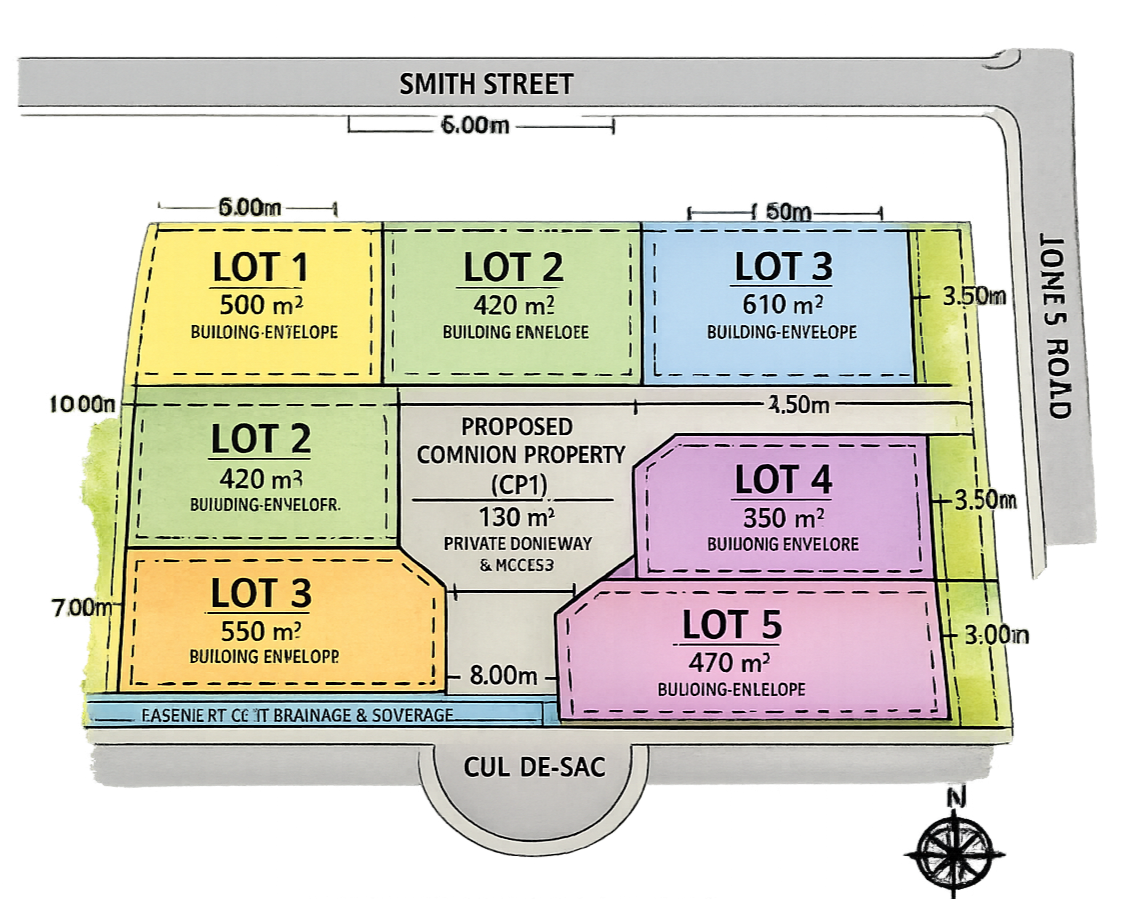
Plans of Subdivision & Consolidation
Subdividing or consolidating land involves both legal and planning requirements. We assist clients with the legal aspects of these processes and work with surveyors, councils and other professionals where required.
-
What is a Plan of Subdivision?
A Plan of Subdivision divides land into separate lots, allowing new titles to be created. Subdivision may be used to create additional lots for sale or development, establish separate titles for multiple dwellings, or formalise changes to property boundaries.
The process can involve planning permits, council certification, service authority requirements, easements and the creation of an Owners Corporation where common property is involved.
-
What is a Plan of Consolidation?
A Plan of Consolidation combines two or more existing titles into a single title. This may be appropriate where adjoining parcels are under the same ownership, as part of a development, or to simplify existing title arrangements.

Family & Spousal Property Transfers
Family and spousal property transfers often arise from personal or family circumstances rather than a traditional sale. These transfers may occur between spouses or partners, between parents and children, or within families as part of a property settlement, estate planning, gifting, or succession arrangements.
While these transactions can appear simple, they still involve legally binding documents, changes to title and compliance with Victorian property law. If not handled correctly, issues can arise later when the property is refinanced, sold, or transferred again.
Common Reasons for Transfers
Family and spousal property transfers often arise:
Following a separation or divorce
Between spouses or domestic partners
Between parents and children
As part of estate planning or succession arrangements
As part of a deceased estate administration
In many cases, no money changes hands or the transfer occurs for nominal consideration only. Even so, legal requirements and tax considerations apply.
Stamp Duty and Legal Requirements
Stamp duty exemptions or concessions may be available in certain circumstances, such as transfers arising from family law property settlements. These exemptions are not automatic and depend on how the transfer is structured and documented.
Careful legal preparation is essential to ensure the transfer:
Complies with Victorian law
Is registered correctly on title
Does not create unintended tax or ownership consequences
We guide clients through family and spousal property transfers by advising on the most appropriate transfer structure, preparing and reviewing transfer documentation, liaising with lenders where a mortgage is involved, ensuring compliance with Land Use Victoria requirements and registering the transfer correctly on title.
Where a transfer forms part of a family law settlement or estate plan, we ensure the property documentation aligns with court orders or broader legal arrangements.
Retail & Commercial Leasing
In Victoria, business leases are generally classified as either retail leases or commercial (non‑retail) leases. The distinction matters because different legal rules apply, and the rights and obligations of landlords and tenants can vary depending on which category a lease falls into.
-
A retail lease is a lease of premises that are used wholly or predominantly to sell or hire goods, or to provide services, to an end consumer. This includes many shopfronts and customer‑facing businesses, and can also apply in circumstances that are not always obvious, including some professional or service‑based businesses.
Retail leases in Victoria are governed by the Retail Leases Act 2003 (Vic). That legislation is designed to provide additional protections for retail tenants and imposes specific obligations on landlords.
Under the Retail Leases Act, landlords are required to provide disclosure documents, tenants cannot be asked to pay certain costs (such as land tax or capital expenses), and minimum lease terms and rent review rules may apply. The Act can override inconsistent lease provisions, meaning that even if a lease says something different, the legislation may prevail.
Whether a lease is captured by the Retail Leases Act can depend on the nature of the business, how the premises are used, and whether any statutory exemptions apply. The classification is not always straightforward and should be considered carefully before a lease is signed.
-
A commercial lease generally applies to premises that fall outside the Retail Leases Act. These often include offices, warehouses, factories, storage facilities and industrial premises, but the classification depends on how the premises are used rather than how they appear.
Commercial leases in Victoria are primarily governed by the terms of the lease itself and general property and contract law, rather than by specific tenant‑protective legislation.
This allows greater flexibility in negotiating terms but also means fewer statutory protections for tenants. Costs, repair obligations, rent review mechanisms, outgoings and termination rights are largely a matter of negotiation between the parties.
Because commercial leases are less regulated, careful legal review is particularly important to ensure the terms properly reflect the parties’ intentions and commercial risk allocation.
-
For landlords, a well‑structured lease provides certainty, protects the value of the property and reduces the risk of disputes.
We assist landlords with preparing and reviewing lease documentation, advising on compliance requirements (including retail leasing obligations), negotiating commercial terms, and managing lease variations, renewals and terminations. We also provide advice if issues arise during the lease term.
-
Entering into a lease is a significant commitment. Many tenants sign leases without fully understanding how terms such as fit‑out obligations, outgoings, rent reviews or options operate in practice.
We assist tenants by reviewing and explaining lease documents in plain language, advising on key commercial risks, and helping negotiate terms where appropriate. Our aim is to ensure the lease aligns with your business plans and that you understand your ongoing obligations before you are locked in.

Farm Leases & Licence Agreements
Farm leasing and licence agreements are commonly used in rural and agricultural settings and play an important role in land use, business continuity and income generation. Whether you are a landowner or an operator, it is important that these arrangements are documented clearly to avoid misunderstandings or disputes.
Although these arrangements are often based on long‑standing relationships or informal agreements, relying on verbal arrangements can create uncertainty and risk. Proper legal documentation helps protect both parties and ensures the arrangement reflects what has actually been agreed.
Farm Leases
A farm lease grants a tenant the right to occupy and use land for agricultural purposes for a defined period of time. Farm leases are commonly used for cropping, grazing, mixed farming, or other rural operations.
Farm leases set out the term of the lease, rent or agistment arrangements, permitted land use, maintenance responsibilities, fencing and water access, and rights at the end of the lease.
Clear lease terms are particularly important where land is used seasonally, where improvements are made to the land, or where the property may be sold or transferred during the lease term.
Licence Agreements
A licence agreement is different from a lease. Rather than granting exclusive possession, a licence allows limited or conditional use of land for a specific purpose. Licences are commonly used for short‑term or flexible arrangements, such as agistment, access rights, storage, or limited use of part of a property.
Licence agreements can be useful where parties want to avoid the creation of long‑term tenancy rights, but they must be carefully drafted. If a licence operates in practice like a lease, it may be treated as a lease regardless of its label, which can have unintended legal consequences.

Adverse Possession
Adverse possession is a legal principle that allows a person to claim ownership of land they have occupied and treated as their own for a long period of time, even though they are not the registered owner.
These claims most commonly arise where boundaries have been treated incorrectly for many years, fences are not in the correct position, or neighbouring land has been used openly without objection. Adverse possession matters are often discovered when a property is being sold, subdivided or redeveloped.
Making an Adverse Possession Application
In Victoria, an adverse possession claim generally requires at least 15 years of continuous, open and exclusive occupation of land without the consent of the registered owner. The occupation must be obvious, uninterrupted and carried out as an owner would treat the land, rather than occasional or shared use.
Applications for adverse possession are usually made through Land Use Victoria and require detailed supporting evidence. This includes surveys, statutory declarations, historical information about the use of the land, and evidence showing that the occupation has been continuous and exclusive over the required period. Not all land can be claimed by adverse possession, and certain categories of land, such as Crown land or land owned by councils or public authorities, are generally excluded from claims.
Because adverse possession applications are technical and evidence‑based, careful preparation is essential. Poorly documented claims may be refused, and incorrect steps can weaken an otherwise valid claim.
Defending an Adverse Possession Claim
Adverse possession does not only affect occupiers. Registered landowners may become aware of a claim being made against their land, or discover that a neighbour may be attempting to establish adverse possession through long‑term use.
Defending an adverse possession claim often involves examining whether the legal requirements have truly been met, including whether the occupation was continuous, exclusive and without consent. In some cases, actions taken by an owner during the relevant period may be sufficient to defeat a claim. Timing and response are critical, as delay can affect a landowner’s rights.
Where a claim is disputed, the matter may involve formal objection processes or court proceedings to resolve the issue and determine ownership.
Section 173 Agreements
-
What is a Section 173 Agreement?
A Section 173 Agreement is a legally binding agreement between a landowner and a local council that places ongoing obligations or restrictions on land. These agreements are made under section 173 of the Planning and Environment Act 1987 (Vic) and are recorded on the title to the property.
Section 173 Agreements are commonly used by councils to control how land can be used or developed. They may restrict further development or subdivision, require certain works to be completed, limit vegetation removal, or ensure ongoing access, drainage or infrastructure obligations are maintained. These agreements are often imposed as a condition of a planning permit and can remain on title for many years.
Because they run with the land, Section 173 Agreements can significantly affect a property’s use, value and future development potential. They must also be disclosed when selling a property, and carefully reviewed by purchasers before entering into a contract.
-
How We Help with Section 173 Agreements
We assist clients by reviewing and explaining Section 173 Agreements in plain English, so it is clear what obligations or restrictions apply and how they affect the property in practice. This includes advising purchasers and vendors as part of a conveyancing transaction and ensuring agreements are properly disclosed to avoid delays, rescission or disputes.
Where a Section 173 Agreement affects proposed development or subdivision, we work alongside planners and other professionals to ensure the legal requirements align with the intended outcome. In some circumstances, it may be possible to vary or remove a Section 173 Agreement, and we provide advice and assistance in dealing with council where changes are sought.
Our approach is practical and focused on clarity, helping clients understand both the short‑term and long‑term implications of Section 173 Agreements before making decisions.

Retirement Villages
Buying into or exiting a retirement village is very different from buying or selling a standard residential property. Retirement village arrangements are governed by specific legislation and often involve complex contractual structures that affect a resident’s rights, costs, and future entitlements.
In Victoria, retirement villages may involve licences, leases, or other occupancy rights rather than full ownership of land. Residents usually pay an ingoing contribution and, on exit, deferred management fees or exit fees may apply. These arrangements can be difficult to understand without legal guidance, particularly as each village operates under its own contractual rules.
Retirement village contracts often regulate issues such as use of the unit, services provided, maintenance responsibilities, resale processes and how exit entitlements are calculated. Because these agreements can affect long‑term financial outcomes, it is important that they are carefully reviewed before entering into a village.
We assist clients at both the entry and exit stages of retirement village living. This includes advising prospective residents and their families before contracts are signed, explaining occupancy rights and financial obligations in clear, practical terms, and reviewing contracts to identify risks or unexpected costs.
We also assist residents or their estates when exiting a retirement village, including advising on resale processes, exit entitlements, deferred fees and timeframes. Where issues arise with operators, or where disputes occur about fees, delays or contract interpretation, we provide advice on available options and next steps.
Our Property Lawyers
-
![Tom Keightley]()
Tom Keightley
Managing Director
-
![Andrew Baird]()
Andrew Baird
Director
-
![Don Robinson]()
Don Robinson
Special Counsel



Our Other Services
-
![Icon of a document with a feather quill, symbolizing writing or editing.]()
Wills & Powers of Attorney
Plan ahead with confidence and protect what matters most. We prepare wills, enduring powers of attorney and medical treatment decision makers tailored to your circumstances, providing clarity and peace of mind for you and your family.
-
![Icon of a gravestone on a pedestal, with a rectangular shape at the top and three horizontal lines below.]()
Probate & Deceased Estates
Guiding executors and families through estate administration with compassion. We assist with probate applications, estate administration and resolving estate issues, helping you meet your obligations with confidence during a difficult time.
-
![Icon representing a group of three people, two larger figures and one smaller figure, on a light blue background.]()
Family Law
Practical legal guidance during life’s most challenging transitions. We advise on divorce, parenting arrangements, property settlements and financial matters, focusing on clear advice and workable outcomes for you and your family.
-
![Illustration of several tall buildings or skyscrapers in shades of blue, arranged in a cluster.]()
Commercial & Business Law
Legal advice to support businesses at every stage. We assist with buying and selling businesses, commercial and retail leasing, contracts, business structures, shareholder and partnership agreements, and succession planning.
-
![Icon of a document with a gavel, representing a legal or judicial document.]()
Litigation & Dispute Resolution
Strategic advice focused on resolution. We act in property, estate and commercial disputes, debt recovery and litigation, helping clients resolve conflicts efficiently through negotiation, mediation or court proceedings where necessary.